
When people search for popular radio stations in Texas, they’re often looking for more than just frequencies. They want stations that deliver great music, trusted local news, sports coverage, entertaining personalities, and reliable streaming options.
Texas has one of the largest and most diverse radio markets in the United States. From country music in rural communities to major sports talk in big cities like Houston, Dallas, Austin, and San Antonio, radio remains an important part of daily life for millions of Texans.
🎵 Similar Stations



Whether you’re a listener looking for new stations, a traveler driving across the state, or an online broadcaster studying successful radio brands, understanding Texas radio offers valuable insight into what audiences continue to enjoy in the streaming era.
Why Radio Remains Popular in Texas
Despite the growth of music streaming services and podcasts, radio continues to thrive across Texas for several reasons:
- Local weather coverage
- Traffic updates
- High school and professional sports
- Community news
- Country music culture
- Live personalities and talk shows
- Emergency information during severe weather
Many Texans still turn on the radio during their morning commute, while working, or during long highway drives where mobile data service may be inconsistent.
The rise of internet streaming has also helped traditional stations reach listeners beyond their broadcast areas.
Most Popular Country Radio Stations in Texas
Country music remains one of the strongest radio formats in Texas.
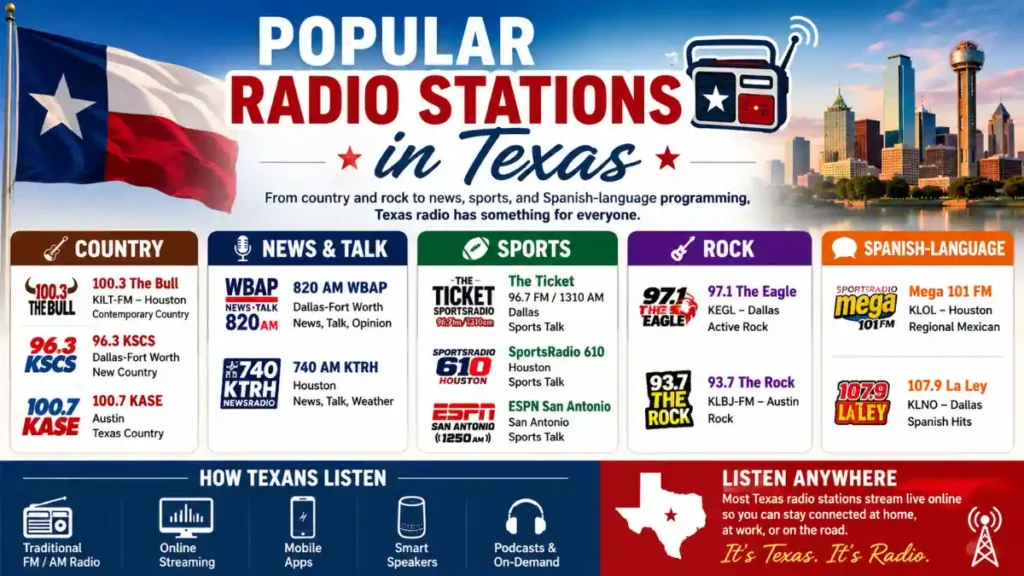
KILT-FM (100.3 The Bull)
Serving the Houston market, this station is known for:
- Contemporary country music
- Popular morning shows
- Concert promotions
- Local Texas artists
Many listeners consider it one of the leading country stations in Southeast Texas.
KSCS (96.3 FM)
KSCS has built a large audience in the Dallas-Fort Worth region through:
- Mainstream country hits
- Artist interviews
- Community events
- Strong local presence
KASE-FM (100.7 FM)
Austin listeners frequently tune in for:
- Texas country
- National country hits
- Live event coverage
- Local entertainment news
Popular News and Talk Radio Stations in Texas
News and talk radio continues to attract loyal audiences, especially among commuters and business professionals.
WBAP (820 AM)
WBAP is one of the most recognized talk radio stations in Texas.
Programming often includes:
- Political discussions
- Breaking news
- Traffic reports
- Local commentary
KTRH (740 AM)
KTRH provides:
- Local news coverage
- National news programming
- Weather updates
- Talk radio shows
For many Houston residents, it serves as a primary source of radio news.
Top Sports Radio Stations in Texas
Sports radio is especially popular because Texas has passionate fan bases for football, baseball, basketball, and college athletics.
The Ticket (96.7 FM / 1310 AM)
Known simply as “The Ticket,” this station has developed a cult-like following through:
- Sports commentary
- Humor-driven segments
- Dallas sports coverage
- Listener interaction
SportsRadio 610
Popular among fans of:
- NFL coverage
- MLB discussions
- Local sports news
- Live interviews
ESPN San Antonio
A major destination for sports fans in South Texas.
Leading Rock Radio Stations in Texas
Rock radio remains a strong format in many Texas markets.
KEGL (97.1 The Eagle)
Features:
- Active rock
- Classic rock favorites
- Concert coverage
- Local rock programming
KLBJ-FM
A long-running Austin station known for:
- Rock music
- Local personalities
- Community engagement
- Live event coverage
Popular Spanish-Language Radio Stations
Texas has a large Spanish-speaking population, making Spanish-language radio a major part of the broadcasting landscape.
KLOL
Known for:
- Regional Mexican music
- Entertainment content
- Community-focused programming
KLNO
Offers:
- Latin music
- Cultural programming
- Local information
- Listener interaction
Spanish-language stations often rank among the highest-rated stations in major Texas markets.
How Texans Listen to Radio Today
Radio listening habits have changed significantly over the last decade.
Traditional FM and AM Broadcasting
Many listeners still use:
- Car radios
- Home stereo receivers
- Portable radios
- Workplace radios
Traditional broadcasting remains important because it works without requiring internet access.
Online Streaming
Most major Texas stations now offer:
- Website streaming
- Mobile apps
- Smart speaker integration
- Connected vehicle access
This allows listeners to stay connected even when traveling outside the station’s signal coverage area.
Podcast and On-Demand Content
Many radio stations now repurpose content into:
- Podcasts
- Recorded interviews
- Highlight segments
- Sports analysis shows
This helps stations compete with modern audio platforms.
Real-World Example: Listening Outside Texas
A former Dallas resident who relocates to another state may still want to follow local sports and news.
Instead of relying on a traditional radio receiver, they can:
- Stream their favorite Texas station online
- Use a station mobile app
- Listen through smart speakers
- Access podcast versions of radio programs
In some cases, geographic restrictions may apply due to music licensing agreements, advertising contracts, or sports broadcast rights.
Important Technical Requirements for Streaming Radio
Whether you’re a listener or broadcaster, several technical factors affect streaming quality.
Internet Speed
Stable streaming generally requires:
| Audio Quality | Recommended Speed |
|---|---|
| 64 kbps | 1 Mbps+ |
| 128 kbps | 2 Mbps+ |
| 256 kbps | 5 Mbps+ |
Audio Processing
Professional stations often use:
- Audio compressors
- Limiters
- Loudness processors
- Streaming encoders
These tools help maintain consistent volume and sound quality.
Streaming Formats
Common formats include:
- MP3
- AAC
- AAC+
- HLS streaming
Each format balances quality and bandwidth differently.
Common Mistakes Listeners Make
Assuming Every Station Streams Worldwide
Some stations restrict streaming due to:
- Licensing agreements
- Sports broadcasting rights
- Geographic restrictions
Using Poor Internet Connections
Buffering often results from:
- Weak Wi-Fi
- Congested networks
- Limited mobile data speeds
Ignoring Station Apps
Many listeners don’t realize station apps may provide:
- Better stream reliability
- Podcast access
- Local event information
- Contest participation
Practical Tips for Finding the Best Texas Radio Stations
Match Stations to Your Interests
Choose based on:
- Country music
- News
- Sports
- Rock
- Spanish-language content
- Local community coverage
Test Multiple Streams
Audio quality can vary between:
- Station websites
- Mobile apps
- Third-party radio directories
Check Local Programming
Stations with strong local programming often provide more value than automated music-only channels.
Use Smart Speakers
Many Texas stations support:
- Amazon Alexa
- Google Assistant
- Connected home audio systems
This makes listening simple and convenient.
The Future of Texas Radio
Texas radio continues adapting to changing listener habits.
Current trends include:
- Hybrid FM and streaming delivery
- Expanded podcast production
- AI-assisted audio workflows
- Mobile-first listening experiences
- Smart dashboard integration in vehicles
While technology continues evolving, local content remains the biggest advantage traditional broadcasters have over global streaming platforms.
Frequently Asked Questions
What are the most popular radio stations in Texas?
Some of the best-known stations include KILT-FM, KSCS, WBAP, KTRH, The Ticket, SportsRadio 610, KEGL, and KLBJ-FM. Popularity varies by city and format.
Can I listen to Texas radio stations online?
Yes. Most major Texas radio stations provide live internet streams through websites and mobile apps.
Why do some radio streams not work outside Texas?
Broadcast rights, licensing agreements, and advertising restrictions can sometimes limit access in certain regions.
What radio format is most popular in Texas?
Country music remains one of the strongest formats, but sports, news-talk, rock, and Spanish-language stations also attract large audiences.
Do Texas radio stations offer podcasts?
Many stations now publish podcasts featuring interviews, talk shows, sports discussions, and special programming.
Is FM radio still popular in Texas?
Yes. FM radio continues to attract large audiences, especially in vehicles, workplaces, and rural communities.
Final Thoughts
The landscape of popular radio stations in Texas reflects the state’s size, diversity, and strong local culture. From country music powerhouses and respected news stations to sports talk leaders and Spanish-language broadcasters, Texas offers something for nearly every type of listener.
Even as streaming services continue growing, radio remains relevant because it delivers local information, trusted personalities, live events, and community connections that many on-demand platforms simply cannot replicate. For listeners, that means more choices than ever. For broadcasters, it highlights the continuing value of creating local content that audiences genuinely care about.
Note: We do not host any streaming content on our servers. All radio streams are links provided by official broadcasters for public use.