
Why Some FM Radio Streams Are Blocked Outside the USA: The long-running debate around international access to American FM radio streams has entered a new phase, and listeners across Europe, Asia, Africa, and Latin America are increasingly encountering the same frustrating message: “This stream is not available in your region.”
For years, internet radio was promoted as a borderless medium. A listener in India could tune into a classic rock station in Texas. A jazz enthusiast in Germany could enjoy a local New York broadcast in real time. That open-access experience is now changing rapidly as broadcasters, music licensing agencies, advertisers, and streaming infrastructure providers tighten geographic restrictions.
🎵 Similar Stations

The issue is no longer limited to premium sports broadcasts or exclusive music events. Even ordinary FM simulcasts are now being blocked outside the United States.
Industry insiders say the reasons are complex, involving copyright laws, royalty disputes, digital advertising contracts, and rising streaming costs. What appears to listeners as a simple “geo-block” message is actually the result of a much larger restructuring taking place inside the online radio business.
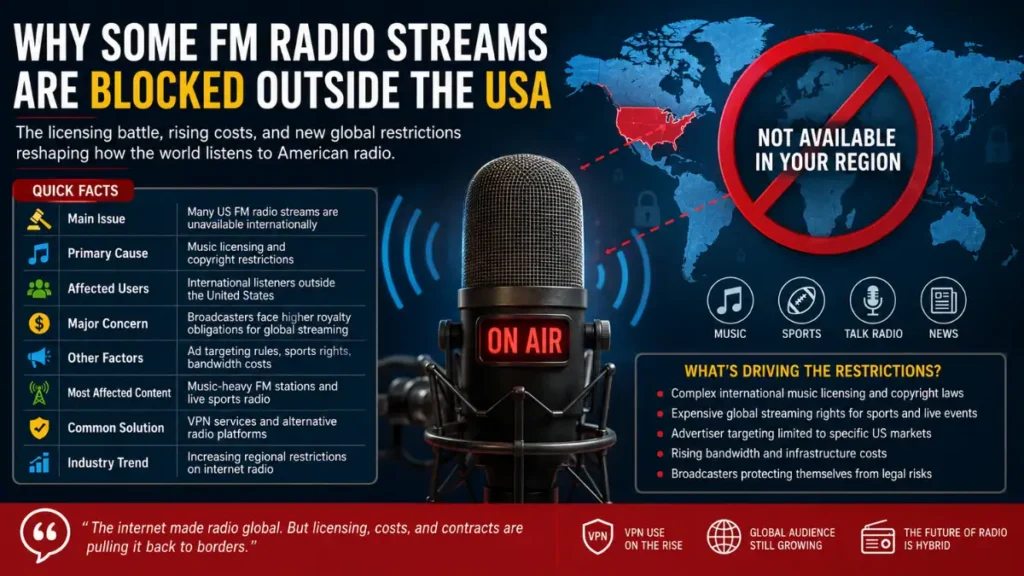
Quick Facts Why Some FM Radio Streams Are Blocked Outside the USA
| Topic | Details |
|---|---|
| Main Issue | Many US FM radio streams are unavailable internationally |
| Primary Cause | Music licensing and copyright restrictions |
| Affected Users | International listeners outside the United States |
| Major Concern | Broadcasters face higher royalty obligations for global streaming |
| Other Factors | Ad targeting rules, sports rights, bandwidth costs |
| Most Affected Content | Music-heavy FM stations and live sports radio |
| Common Solution | VPN services and alternative radio platforms |
| Industry Trend | Increasing regional restrictions on internet radio |
The End of the “Borderless Radio” Era
When FM stations first expanded online in the early 2000s, the internet created an entirely new opportunity for broadcasters. Small local stations suddenly gained international audiences without building satellite networks or expensive overseas infrastructure.
This transformation helped American radio brands grow global fan communities. Stations focused on country music, talk radio, hip-hop, EDM, and sports attracted listeners far beyond their local markets.
The model appeared sustainable for years because digital streaming regulations had not fully caught up with the pace of internet expansion. Many broadcasters simply treated online streaming as an extension of terrestrial FM broadcasting.
That assumption no longer holds.
Music rights organizations and copyright agencies have become far more aggressive in monitoring international distribution. Streaming a song inside the United States and streaming the same song to a listener in another country can involve entirely different licensing obligations.
As digital consumption exploded during the pandemic years, rights holders began demanding stricter enforcement and more accurate royalty accounting.
The result is visible today across hundreds of FM station websites and apps.
Why Music Licensing Became the Biggest Problem
At the center of the issue lies music licensing.
Traditional FM radio inside the United States operates under a specific regulatory framework. Stations pay licensing fees through organizations such as ASCAP, BMI, SESAC, and SoundExchange. Those agreements are primarily structured around domestic broadcasting.
Internet streaming changes the equation completely.
Once a station broadcasts globally online, it may trigger international licensing requirements involving multiple territories and separate copyright agencies. Managing those rights can become extremely expensive for small and medium-sized broadcasters.
Industry analysts say many stations discovered they were unintentionally serving large international audiences without having proper licensing coverage.
That created two major risks:
- Higher royalty liabilities
- Potential legal disputes from rights holders
Instead of negotiating expensive global agreements, many broadcasters adopted geo-blocking systems that restrict access to US listeners only.
This is particularly common among:
- Commercial music stations
- Sports radio networks
- Syndicated entertainment channels
- Stations carrying premium live programming
Talk radio and news stations generally face fewer restrictions because spoken-word content does not involve the same music licensing complexity.
Sports Rights Have Added Another Layer of Restrictions
Music is not the only factor driving geo-blocking.
Sports broadcasting rights have become one of the most tightly controlled segments in global media. American radio stations carrying live NFL, NBA, MLB, NHL, or college sports commentary often operate under contracts that limit international redistribution.
A station may legally broadcast a baseball game locally over FM frequencies but may not possess digital international streaming rights.
This distinction has become increasingly important as global sports audiences continue to grow.
Media companies now treat international streaming rights as premium assets. Separate agreements are sold to broadcasters, streaming platforms, and regional partners across different countries.
Allowing unrestricted global access through a local FM station stream could undermine those deals.
Because of this, many stations automatically disable streams during live sports events or block overseas listeners entirely.
Advertising Economics Are Also Changing
Digital advertising has quietly become another reason behind geographic restrictions.
Most local American radio stations depend heavily on regional advertisers. Their advertising clients are paying to reach listeners in specific US markets — not audiences in Europe or Asia.
A Texas car dealership gains little value from listeners in India. A local restaurant promotion in Chicago becomes irrelevant to users in South America.
As advertising technology evolved, broadcasters started focusing more on audience targeting and measurable engagement metrics. International listeners, while valuable from a popularity standpoint, often contribute little to local ad revenue.
Streaming infrastructure, however, still costs money.
Large international audiences can significantly increase:
- Bandwidth usage
- CDN expenses
- Server load
- App maintenance costs
For smaller broadcasters operating on tight margins, blocking overseas traffic became a financially practical decision.
Streaming Costs Are Rising Faster Than Many Expected
The economics of online radio have shifted dramatically over the past decade.
Initially, streaming costs were relatively manageable because audiences were smaller and audio quality standards were lower. Modern listeners now expect high-bitrate streams, mobile compatibility, smart speaker support, and uninterrupted playback.
Those upgrades require more robust infrastructure.
Industry experts say several independent FM stations underestimated how expensive global digital broadcasting would become at scale.
A station with thousands of overseas listeners may face:
- Higher cloud delivery expenses
- Increased licensing calculations
- Greater cybersecurity demands
- Additional compliance requirements
For corporate radio groups, those costs are easier to absorb. Smaller independent stations often cannot justify unrestricted global access.
That financial pressure has accelerated the spread of geo-restriction technology.
VPN Usage Has Surged Among Radio Listeners
As restrictions increased, many listeners began turning to VPN services to bypass geographic blocks.
VPNs allow users to route internet traffic through US-based servers, making it appear as though they are accessing streams from inside the country.
This workaround has become increasingly common among expatriates, international music fans, and sports listeners.
Search interest related to phrases such as:
- “How to listen to US radio outside America”
- “FM radio stream blocked”
- “Best VPN for radio streaming”
has grown significantly over recent years.
Broadcasters are aware of this trend, and some have started implementing stronger anti-VPN detection systems. Others tolerate VPN traffic because it still contributes to audience numbers and engagement statistics.
The situation remains inconsistent across the industry.
Some Stations Are Choosing Alternative Global Strategies
Not every broadcaster is embracing geo-blocking.
Some stations have shifted toward international licensing agreements or partnered with global radio aggregation platforms to maintain worldwide accessibility.
These platforms negotiate broader streaming rights and distribute channels through centralized apps.
A growing number of stations are also experimenting with:
- Subscription-based streaming
- Ad-free premium access
- Region-specific content feeds
- Podcast-focused distribution
This reflects a larger transformation happening across audio media.
Radio is gradually moving away from purely local broadcasting and evolving into a hybrid digital ecosystem that blends FM transmission, apps, podcasts, smart speakers, and on-demand content.
The Listener Experience Is Becoming Fragmented
One major consequence of these restrictions is fragmentation.
Listeners who previously relied on a station’s official website now find themselves navigating multiple apps, third-party platforms, and region-specific services.
This creates confusion for users who assume internet radio should function universally.
In some cases:
- The station website blocks access
- The mobile app works partially
- Aggregator platforms carry alternate feeds
- Sports segments disappear during live events
The inconsistency reflects how licensing agreements differ between platforms and territories.
For consumers, the experience feels unpredictable.
For broadcasters, it represents a complicated balancing act between compliance, revenue, and audience growth.
Why This Matters Beyond Radio
The FM streaming debate reflects a much larger issue across digital media.
Movies, television, sports, podcasts, and music streaming platforms are all facing similar tensions between global internet accessibility and region-based licensing systems.
The internet was built around openness. Media rights industries were built around territorial control.
Those two models continue to collide.
Radio simply happens to be one of the most visible examples because listeners became accustomed to free and unrestricted access for so many years.
Now, the business realities behind digital distribution are becoming impossible to ignore.
Radio Think’s View
The growing number of blocked FM streams outside the United States signals a structural shift in the radio industry rather than a temporary technical issue.
Broadcasters are under increasing pressure from licensing agencies, advertisers, and infrastructure costs. Geo-blocking has become the easiest short-term solution, especially for smaller stations operating with limited digital budgets.
At the same time, audience behavior is changing rapidly. International listeners are no longer passive users. They represent highly engaged communities that often discover stations through social media, smart speakers, and search engines rather than traditional FM signals.
That creates an important dilemma for the industry.
Blocking overseas audiences may reduce legal and financial risk, but it also limits global brand growth at a time when digital audio competition is intensifying. Podcasts, Spotify playlists, YouTube streams, and AI-driven audio platforms are already competing aggressively for listener attention.
Stations that completely close international access could lose long-term relevance among younger digital audiences.
The likely future is a hybrid model where broadcasters offer:
- Region-specific streams
- Licensed international feeds
- Subscription-based premium listening
- Dynamic advertising by territory
The era of unrestricted global FM streaming is fading, but international demand for American radio remains extremely strong. That demand is unlikely to disappear.
What changes next will depend on whether broadcasters choose protection first — or expansion first.
Also Read: Best Free VPN for Internet Radio Streaming
Note: We do not host any streaming content on our servers. All radio streams are links provided by official broadcasters for public use.