
The long-running debate inside the internet radio industry has once again returned to the spotlight. As independent broadcasters, online radio startups, and digital media companies continue searching for reliable streaming infrastructure, two names remain at the center of the conversation — SHOUTcast and Icecast.
For years, these two platforms have powered thousands of online radio stations across the world. From hobby broadcasters operating from small studios to large-scale commercial streaming networks, both technologies have built strong reputations. Yet the market around them has changed dramatically. Cloud hosting, mobile streaming, AI-driven audio recommendations, podcast integration, and low-latency broadcasting are now redefining the digital audio business.
🎵 Similar Stations



That shift has raised a major question inside the industry: which platform is better prepared for the future of internet radio?
SHOUTcast vs Icecast Comparison: The Streaming Battle That Still Shapes the Future of Internet Radio
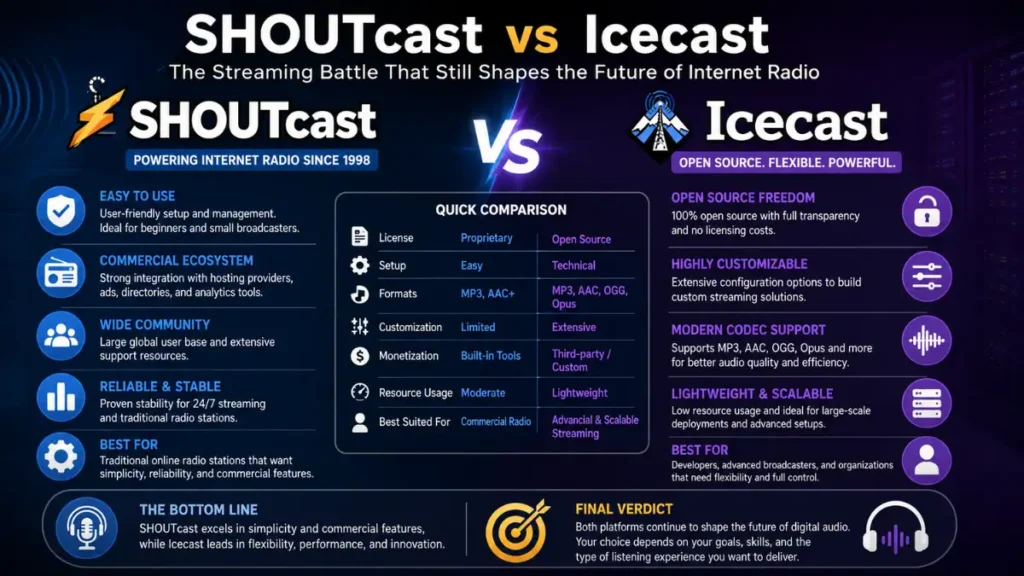
Quick Facts: SHOUTcast vs Icecast
| Feature | SHOUTcast | Icecast |
|---|---|---|
| Developer | Nullsoft / Radionomy ecosystem | Xiph.Org Foundation |
| License Type | Proprietary | Open Source |
| Primary Use | Commercial internet radio | Flexible streaming infrastructure |
| Supported Formats | MP3, AAC+ | MP3, AAC, OGG, Opus |
| Ease of Setup | Beginner-friendly | Technical but highly customizable |
| Monetization Support | Strong commercial integration | Depends on third-party tools |
| Community Support | Large broadcaster community | Strong developer community |
| Resource Usage | Moderate | Lightweight |
| Customization | Limited compared to Icecast | Extensive |
| Best For | Traditional online radio stations | Advanced and scalable streaming setups |
The Origins of Internet Radio Streaming
To understand why this debate continues today, it is important to look back at the rise of internet radio itself.
During the late 1990s and early 2000s, internet radio experienced explosive growth. Broadband access was expanding, music discovery was changing, and audiences were becoming comfortable consuming media online instead of through traditional FM and AM signals.
SHOUTcast emerged as one of the earliest major solutions for audio streaming. Developed by Nullsoft, the platform quickly became popular because of its simplicity. Broadcasters could launch stations without investing heavily in technical infrastructure.
At almost the same time, Icecast entered the market with a very different philosophy. Backed by the Xiph.Org Foundation, Icecast focused on open standards, transparency, and flexibility. Developers appreciated its ability to support multiple formats and adapt to custom workflows.
What started as a technological difference eventually became a philosophical divide inside the streaming industry.
Why SHOUTcast Became the Industry Standard for Beginners
One reason SHOUTcast gained widespread adoption was accessibility.
Setting up a SHOUTcast server traditionally required fewer technical adjustments. Many hosting providers integrated SHOUTcast directly into their radio hosting packages, making it attractive for small broadcasters entering the market for the first time.
Several advantages helped SHOUTcast dominate commercial internet radio during its peak years:
- Easy encoder compatibility
- Broad hosting support
- Large public station directories
- Familiar dashboard environment
- Stable MP3 streaming support
- Simplified monetization integration
For broadcasters focused mainly on music streaming rather than server engineering, SHOUTcast reduced operational complexity.
The platform also benefited from timing. During the rise of Winamp culture and early online music communities, SHOUTcast became deeply associated with digital radio experimentation.
That early momentum still matters today.
Icecast’s Rise Among Developers and Independent Broadcasters
While SHOUTcast appealed to commercial broadcasters, Icecast gradually built influence among developers, engineers, and open-source advocates.
Its biggest strength has always been flexibility.
Unlike SHOUTcast, Icecast supports multiple codecs and formats more naturally, including:
- OGG Vorbis
- Opus
- AAC
- MP3
This flexibility allowed broadcasters to optimize bandwidth efficiency and streaming quality more effectively.
The open-source nature of Icecast also made it attractive for organizations that wanted complete control over their infrastructure.
Universities, community radio stations, experimental broadcasters, and nonprofit media projects increasingly adopted Icecast because they could customize server behavior without licensing restrictions.
As streaming technology evolved, this adaptability became a significant competitive advantage.
The Performance Debate: Stability vs Customization
Industry experts often describe the SHOUTcast vs Icecast comparison as a battle between operational simplicity and technical freedom.
SHOUTcast Strengths
SHOUTcast continues to perform well in several critical areas:
- Reliable uptime for standard radio broadcasting
- Simple deployment
- Familiar ecosystem
- Strong compatibility with radio automation tools
- Easier onboarding for beginners
For broadcasters whose main objective is maintaining a stable 24/7 music station, SHOUTcast remains a dependable option.
Icecast Strengths
Icecast, however, offers deeper technical capabilities:
- Lower resource consumption
- Better scalability flexibility
- Advanced configuration support
- Native support for modern codecs
- Strong Linux ecosystem integration
Large streaming operations often prefer Icecast because infrastructure teams can fine-tune server behavior according to traffic patterns and audience demand.
This distinction becomes increasingly important as streaming audiences grow globally.
Also Read: Best Internet Radio Hosting Platforms
Audio Quality and Codec Efficiency
Audio delivery has become one of the most important competitive areas in streaming technology.
Modern listeners expect high-quality audio with minimal buffering. Mobile consumption has also increased pressure on broadcasters to reduce bandwidth usage while maintaining sound clarity.
This is where Icecast has gained strong credibility.
Its support for Opus and OGG codecs allows broadcasters to achieve impressive audio quality at lower bitrates. For mobile-heavy audiences in regions with inconsistent internet connectivity, that efficiency matters significantly.
SHOUTcast still performs strongly with MP3 and AAC+, especially for stations focused on broad device compatibility. Yet industry analysts increasingly view codec flexibility as a long-term advantage for Icecast.
The streaming market is gradually moving toward efficiency-driven delivery systems.
Monetization: A Key Commercial Difference
Commercial radio operators often prioritize monetization tools over technical customization.
SHOUTcast historically positioned itself more aggressively in the commercial broadcasting space. Advertising integrations, public station directories, listener analytics, and business-focused hosting partnerships helped the platform maintain relevance.
For internet radio businesses that depend heavily on advertising revenue, sponsorships, and listener metrics, SHOUTcast still provides a more straightforward commercial ecosystem.
Icecast, by contrast, operates more like a framework than a packaged commercial product.
Monetization features usually require third-party integrations or custom development work. That creates additional setup complexity but also allows broadcasters to build highly personalized business models.
The choice often depends on scale and technical expertise.
Security and Infrastructure Challenges
The streaming industry now faces challenges that barely existed during the early internet radio era.
These include:
- DDoS attacks
- Bandwidth spikes
- CDN dependency
- Mobile app integration
- API-based broadcasting
- Cloud migration
Both SHOUTcast and Icecast have adapted to modern demands, but infrastructure experts often favor Icecast for enterprise-level customization.
Because it is open source, development communities can respond faster to emerging technical requirements. Security patches and server modifications can also be deployed more independently.
SHOUTcast users sometimes depend more heavily on ecosystem-level updates and vendor-controlled changes.
That distinction has become increasingly relevant as broadcasters seek long-term scalability.
The Influence of Podcasting and On-Demand Audio
The rise of podcasting has transformed audience expectations.
Listeners no longer consume audio exclusively through live radio streams. They now expect hybrid experiences that combine:
- Live broadcasting
- On-demand episodes
- Personalized recommendations
- Smart speaker compatibility
- Mobile-first interfaces
This transition is affecting streaming infrastructure decisions.
Icecast’s open architecture often makes podcast integration easier for developers building custom audio ecosystems.
SHOUTcast still performs strongly for traditional continuous-stream radio stations, but some newer digital media companies are choosing flexible open-source solutions to future-proof their platforms.
The industry is no longer centered only around linear broadcasting.
Hosting Providers and Market Trends
Radio hosting companies continue offering support for both platforms, though market trends reveal subtle shifts.
Smaller hosting providers still heavily promote SHOUTcast because many entry-level broadcasters recognize the brand immediately.
At the same time, developer-focused hosting environments increasingly support Icecast deployments due to containerization, cloud compatibility, and Linux-based server optimization.
Streaming infrastructure has become more technical than it was a decade ago.
Broadcasters today are not only building radio stations. They are building full digital audio ecosystems.
Which Platform Is Better for New Broadcasters?
The answer depends largely on operational priorities.
SHOUTcast May Be Better If:
- You want fast setup
- You run a traditional music radio station
- You prefer commercial hosting support
- You need easier management tools
- You prioritize simplicity
Icecast May Be Better If:
- You want full customization
- You operate at larger technical scale
- You need modern codec flexibility
- You prefer open-source infrastructure
- You plan advanced integrations
The decision is less about which platform is objectively superior and more about broadcaster goals.
The Future of Internet Radio Infrastructure
The internet radio market is entering another transformation phase.
AI-driven recommendation systems, metadata automation, cloud broadcasting, and low-latency delivery are reshaping how digital audio platforms operate.
In this environment, flexibility may become the defining competitive factor.
Open-source ecosystems like Icecast are positioned well for rapid adaptation. Yet SHOUTcast’s ease of use and established broadcaster network continue giving it strong market presence.
Industry analysts believe both platforms will remain relevant, though likely serving different categories of broadcasters in the years ahead.
The divide between “easy broadcasting” and “advanced infrastructure control” is becoming sharper.
Radio Think’s View
At Radio Think, the SHOUTcast vs Icecast debate represents more than a technical comparison. It reflects the broader evolution of internet broadcasting itself.
SHOUTcast still dominates among traditional online radio operators because simplicity matters. Many independent broadcasters care more about staying live consistently than experimenting with server architecture.
Icecast, however, appears increasingly aligned with the future direction of digital audio technology. The streaming industry is moving toward open ecosystems, scalable infrastructure, and codec efficiency. These trends strongly favor customizable platforms.
Data from hosting communities and streaming developers also suggests that technically skilled broadcasters are gradually shifting toward flexible open-source systems.
That does not mean SHOUTcast is becoming obsolete. Its brand recognition, accessibility, and commercial ecosystem remain powerful advantages.
The market is unlikely to produce a single winner.
Instead, the industry appears to be splitting into two parallel paths:
- Simplified commercial broadcasting
- Advanced customizable streaming ecosystems
Both SHOUTcast and Icecast are expected to remain central players in that future.
Note: We do not host any streaming content on our servers. All radio streams are links provided by official broadcasters for public use.